Sunday, 8 February 2015

Wet Finished Double Weave - Improved my Sample but Ruined my 6 metres of Upholstery Fabric!!

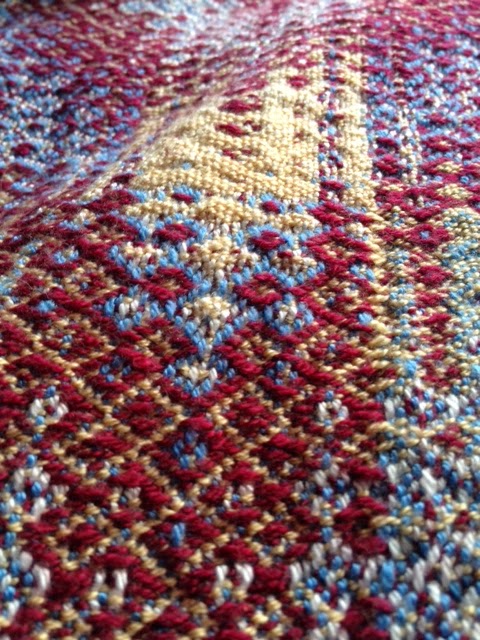
After Wet Finishing
Washed and pressed the sample and the changes to the structure afterwards has stopped it looking like an unintended glitch in the pattern. The relaxing of the threads has, as I expected, evened out interlacement so the change is softer. But the biggest effect is due to the definite pebbly texture it now has - a result of the differential behaviour between the pocket weave and integrated sections.


After Wet Finishing
The raised patches of plain weave pockets can be clearly seen in the wet finished photo of the earlier project from the same warp and threading.  I wet finished this too, BIG MISTAKE and don't know what I was thinking really, because I needed the crisp, stiff , upholstery-type 'as woven' finish for this because it was to be panels for a vanity screen. Now it's all springy, soft and elastic and not really suitable for this at all Duhhhhhh....IDIOT!!!!

Saturday, 7 February 2015

Not sure I am getting the effect I was hoping for??

I can't decide whether the 'illusion' of the curve in the horizontal weft looks more like an error in the weaving than a deliberate design?

Interested to know what other's think.

The effect is actually more prevalent in the photo than I am seeing it on the loom so maybe when its wet finished and pressed it will look OK...still not sure I like it.

Thinking perhaps just the off-centre 'break' in the pattern and not the other two?

Wednesday, 4 February 2015

Double Weave and Illusion inspired by Marian Stubenitsky

Marian Stubenitsky posted some photos today of some superb woven panels based on optical illusion and it got me thinking as I have had the classic curved line illusion in mind for some time: since I started looking at the Hubble images.


 With a warp already on the loom, I had just finished a new, very geometric draw-down using this threading from the last project and it gave me the idea that I could use the double weave to create patches of the (diagonal) twill as in (b) then mess-around with the treadling to control the colour mix  across these areas, using the horizontal weft lines, to give the impression of curves.


To my un-ending surprise, it worked!


I changed the tie up method to the one on p111 (which is particularly easy with my software) as it's much easier to see what your doing in each layer.


Right, off to weave it now though I might modify these treadling design lines in Photoshop first so I can stretch them x4, as I know this is going to weave at 16th/cm, so it's going to have an aspect ratio of 13/16 and would prefer much elongated diamond ending up with a 35cm x 110cm panel.

Tuesday, 3 February 2015

Echo Double Weave Project Retrospective

Photos of the project whilst on the loom and the finished 6 metre roll of yarn.

Half the woven length used a weft pairing in Burgundy and Gold Tencel (which can be seen as the fabric under the front beam), whilst the other half produces a lighter complimentary shade using Red and White Gold yarn.


Close up detail. The random changes in the lift ratio in the tie up break up the uniformity of the pattern by introducing patches of colour where the ratio suddenly changes.

The textural effect of the plain weave areas amongst the 2:2 twill is one I particularly like as they coincide with the areas of colour change.


The finished article - the lighter shade is on the left. This will be made into framed panels to form a vanity screen. I will post pics of the finished project when it's done......but as my woodworking workshop resembles the aftermath of a gas explosion, it 'aint going to be any time soon :-(

Monday, 2 February 2015

Echo Double Weave Project

This is what I have been working on since late summer. The project is finished, in that 6 metres of material is off the loom and ready to be made into panels for the vanity screen.

This is the technical information for the project. It's based on "Echo and Iris".


DESIGN TECHNICAL FACT SHEET

Weave Structure: Double Weave: Plain + 2:2 Twill with Basic Ratio of 10:2 and Plain Weave Design Elements
No. of Shafts; 24
Category: 4 Colour Double Weave
Threading: 500 ends advancing threading - Echo 2 with offset 12
13epcm (6.5epcm per layer)
Treadling: Advancing diagonal treadling. 364 pick repeat. Each repeat is advanced x2 (wrap x2) repeated 12 times giving total of 4732 picks.

Yarn 10/2 Tencel woven 16ppcm


File Location: Double Weaves/myfirstproject/projectinformation/


Wednesday, 28 January 2015

Back!

Bought new puter last summer with Windows 8 and couldn't find a way into my Blog and couldn't really be bothered to delve into sorting it!  Well now I have so can post again :-)

Monday, 18 August 2014

Echo, Iridescence and Double Weave for Dummies!

UPDATED 19 SEPTEMBER:
Spent at least the last month iterating and reiterating the sections on double weave in the book (Echo and Iris) before I really got my head round it. This is a fantastic book and I would recommend it to anyone other than a beginner. Whilst the earlier chapters 'teach' the materiel clearly, I feel the double weave sections could do with more alliteration and a few extra steps in the explanations; just a little too much is assumed and left hanging on the assumption the reader will make the link, though to be fair I have done so and others might be able to do so easier and quicker than I.

The breakthrough for me with the double weave sections was working out how to quickly produce drawdowns on my software: as with the echo/iris sections, this enabled me to experiment, make the 'missing' links whilst an idea was fresh and work out my own rubrics for the techniques. Fortunately, the alternative approach given in the book for producing tie-ups in double weave fitted perfectly with WeaveIt's software (without that, producing drafts for 32 shaft double weave is VERY laborious; you 'aint going to do too many of those 'manually' before you get fed up and just plump for the first iteration of your design!).

Once grasped though, the technique with echo and iridescence really does take double weave to a level beyond anything I have seen, read or heard of before; as with the earlier sections, it's really inspirational work so looking forward to trying the first design I have produced.

In order to readily use the techniques in the book to produce and experiment with lots of design variations I now have what amounts to a 'Mike's Dummy's Guide to Echo and Iris for WeaveIt' - about a dozen step by step instruction sheets for each technique. For anyone using WeavIt they would make a useful appendix to either this book or the WeavIt manual.